
The Afronauts at the Royal Court – review
The world premiere play, written by Ryan Calais Cameron, runs until 19 December
 |
London
|
24 November 2026
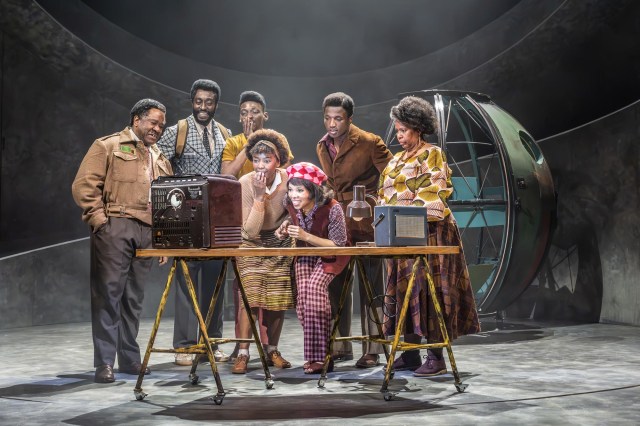
On entering the Royal Court, the stage is cloaked in a black curtain covering the stage with The Afronauts logo beamed across it, giving no warning whatsoever of what comes next: a painfully bright white light hits the audience, almost as if they’re seated in the afterburners of a rocket. Behind it an astronaut floats effortlessly before we are bought down into the world of the play itself.
That world is a design delight. Soutra Gilmour has built the lair of a Bond villain: a single sweeping walkway, and one enormous skylight that points the eye to the heavens and beyond.
It’s 1964, and the space race is kicking off. The Americans and the Russians are busy staking their claims on the heavens and, unbeknownst to the rest of the world, so is Zambia. On the brink of freedom from the British, a teacher named Edward (Lucian Msamati) has decided that his country will not be left behind: he intends to put a Zambian on the moon, and to get there before anyone else.
His headquarters is a garage, his chief engineer a former NASA employee who cannot find work anywhere else, and his crew four would-be astronauts, or “Afronauts” as they style themselves, who are idealistic to their fingertips. The new government wants nothing to do with it; people from his past give him a very wide berth. His is a plan built on ego, cloaked in nationalistic pride.
For a good while, this is a giddy, mischievous comedy of garage engineering, all hand-built hope and banter, with a rocket slowly taking shape out of enthusiasm and not a great deal else. Then the laughs begin, ever so gently, to curdle. Edward’s grand speeches start to sound less like a vision for a nation and more like a man keeping a close eye on his own reflection, and the play lets us work out for ourselves just how much of the dream is his and how much belongs to the people he is asking to carry it.

Msamati is a delight as the impishly enthusiastic teacher and unsettling as his ego takes control of his better judgement, while Ama Qamata gives Matha, Edward’s Afronaut of choice, a quiet, stubborn dignity from within her teenage giddiness. It is an enchanting two-hander that anchors an ensemble cast that is every bit as good.
Ryan Calais Cameron’s script is poignant and funny, with quotable lines in such supply that it reads like a greatest hits collection. His “true-ish” take on this story is as much about hope, belonging, glory and deceit as it is about rockets, and the infectious score by Khalil Madovi places us as much in the time of the piece as it does the location.
At a little over two and a half hours, The Afronauts could comfortably lose 20 minutes, but that’s missing the point. This is a show unafraid to take its time in telling a story of a man up against the clock (he wants to be the first). It gives its characters space to develop and be more than frippery on a story about a man and his rocket fixation. This slightly relaxed approach to timing gives us a gentle depth and engagement that could so easily be lost.
An ambiguous ending will not be to everybody’s taste but a quick search will give completists any answers they seek, and it is a fitting way to leave a play about striving for something you may never achieve.
The Afronauts is a funny, bruising and beautifully realised play that earns its running time and then some. Cameron has written something that sends you out wanting to reach for the stars and beyond.





source on Google
Featured In This Story

Related Articles
See all

Latest Reviews
See all








Latest Videos

Pride the Musical opens at the Bridge Theatre… and the VIPs ask the questions!
Ready for a “Bloody Good Night Out”?!